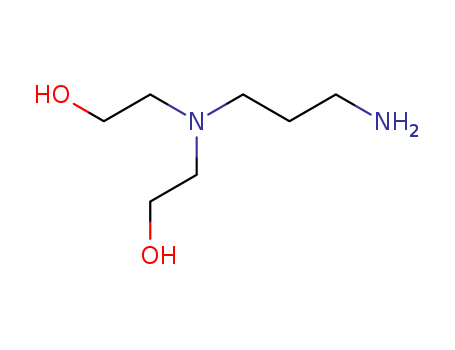
N-(3-AMINOPROPYL)DIETHANOLAMINE
- Name: N-(3-AMINOPROPYL)DIETHANOLAMINE
- CAS: 4985-85-7
- Purity: 99%
Details
Manufacturer supply top purity N-(3-AMINOPROPYL)DIETHANOLAMINE 4985-85-7 with GMP standards
- Molecular Formula: C7H18N2O2
- Molecular Weight: 162.232
- Appearance/Colour: colorless liquid with a faint fishlike odor
- Vapor Pressure: 3.45E-05mmHg at 25°C
- Refractive Index: 1.4985 (589.3 nm 27℃)
- Boiling Point: 316.5 °C at 760 mmHg
- PKA: 14.40±0.10(Predicted)
- Flash Point: 145.2 °C
- PSA: 69.72000
- Density: 1.081 g/cm3
- LogP: -0.67790
N-(3-AMINOPROPYL)DIETHANOLAMINE(Cas 4985-85-7) Usage
|
General Description |
A colorless liquid with a faint fishlike odor. May burn though N-(3-AMINOPROPYL)DIETHANOLAMINE may require some effort to ignite. Corrosive to tissue. Produces toxic oxides of nitrogen during combustion. |
|
Air & Water Reactions |
Water soluble. |
|
Reactivity Profile |
N-(3-AMINOPROPYL)DIETHANOLAMINE is an aminoalcohol. Amines are chemical bases. They neutralize acids to form salts plus water. These acid-base reactions are exothermic. The amount of heat that is evolved per mole of amine in a neutralization is largely independent of the strength of the amine as a base. Amines may be incompatible with isocyanates, halogenated organics, peroxides, phenols (acidic), epoxides, anhydrides, and acid halides. Flammable gaseous hydrogen is generated by amines in combination with strong reducing agents, such as hydrides. |
|
Health Hazard |
TOXIC; inhalation, ingestion or skin contact with material may cause severe injury or death. Contact with molten substance may cause severe burns to skin and eyes. Avoid any skin contact. Effects of contact or inhalation may be delayed. Fire may produce irritating, corrosive and/or toxic gases. Runoff from fire control or dilution water may be corrosive and/or toxic and cause pollution. |
|
Fire Hazard |
Non-combustible, substance itself does not burn but may decompose upon heating to produce corrosive and/or toxic fumes. Some are oxidizers and may ignite combustibles (wood, paper, oil, clothing, etc.). Contact with metals may evolve flammable hydrogen gas. Containers may explode when heated. |
|
Flammability and Explosibility |
Nonflammable |
InChI:InChI=1/C7H18N2O2/c8-2-1-3-9(4-6-10)5-7-11/h10-11H,1-8H2/p+2
4985-85-7 Relevant articles
Cobalt complexation with unsymmetrical tripodal ligands
Jocher, Christoph,Pape, Tania,Hahn, F. Ekkehardt
, p. 667 - 672 (2007/10/03)
The reaction of the aliphatic unsymmetri...
Synthesis and properties of oligo-2′-deoxyribonucleotides containing internucleotidic phosphoramidate linkages modified with pendant groups ending with either two amino or two hydroxyl functions
Asseline, Ulysse,Chassignol, Marcel,Draus, Jolanta,Durand, Maurice,Maurizot, Jean-Claude
, p. 3499 - 3511 (2007/10/03)
Single and multiple incorporations of st...
Synthesis and DNA-Sequence Selectivity of a Series of Mono- and Difunctional 9-Aminoacridine Nitrogen Mustards
Kohn, Kurt W.,Orr, Ann,O'Connor, Patrick M.,Guziec, Lynn James,Guziec, Frank S.
, p. 67 - 72 (2007/10/02)
The aim of this work was to identify nit...
Hydroformylation of olefins using azoxy-dentated ligands
-
, (2008/06/13)
At a temperature in the range 100° C to ...
4985-85-7 Process route
-
![3-[bis(2-hydroxyethyl)amino]propionitrile](/upload/2026/5/e678d60c0ea04032946303fb2f24f438_785a4674-c0d4-4240-916e-fcb86694c3e4.png)
-
17209-72-2
3-[bis(2-hydroxyethyl)amino]propionitrile

-
![2,2'-[(3-aminopropyl)imino]bis-ethanol](/upload/2026/5/05342a9a42f34c3f94963d36120efd54_dae98163-6f4d-4e12-8d26-3f9313736491.png)
-
4985-85-7
2,2'-[(3-aminopropyl)imino]bis-ethanol
| Conditions | Yield |
|---|---|
|
With
lithium aluminium tetrahydride; sulfuric acid;
In
tetrahydrofuran;
at 20 ℃;
for 8h;
|
32%
|
|
With
ethanol; nickel;
at 105 ℃;
Hydrogenation.unter Druck;
|
|
|
With
ammonia; hydrogen;
nickel;
In
ethanol;
|
|
|
With
lithium aluminium tetrahydride;
In
tetrahydrofuran;
Heating;
|
-
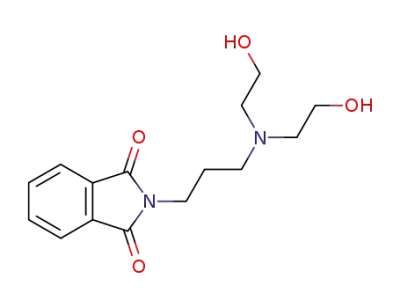
-
118811-21-5
N-(3-phthalimidopropyl)diethanolamine
-
-
4985-85-7
2,2'-[(3-aminopropyl)imino]bis-ethanol
| Conditions | Yield |
|---|---|
|
With
hydrazine hydrate;
In
methanol;
for 2.5h;
Heating;
|
80%
|
4985-85-7 Upstream products
-
17209-72-2
3-[bis(2-hydroxyethyl)amino]propionitrile
-
5460-29-7

2-(3-bromopropyl)isoindole-1,3-dione
-
111-42-2

2,2'-iminobis[ethanol]
-
64-17-5

ethanol
4985-85-7 Downstream products
-
103650-17-5
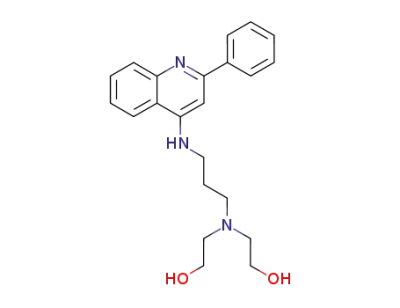
N ,N -bis-(2-hydroxy-ethyl)-N '-(2-phenyl-[4]quinolyl)-propanediyldiamine
-
103509-57-5

N '-[2-(4-chloro-phenyl)-[4]quinolyl]-N ,N -bis-(2-hydroxy-ethyl)-propanediyldiamine
-
80092-43-9
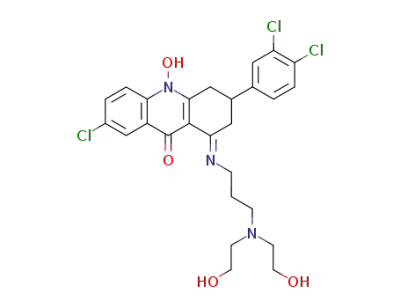
1-{(E)-3-[Bis-(2-hydroxy-ethyl)-amino]-propylimino}-7-chloro-3-(3,4-dichloro-phenyl)-10-hydroxy-1,3,4,10-tetrahydro-2H-acridin-9-one
-
80108-17-4

1-{(E)-3-[Bis-(2-hydroxy-ethyl)-amino]-propylimino}-7-chloro-10-hydroxy-3-(4-trifluoromethyl-phenyl)-1,3,4,10-tetrahydro-2H-acridin-9-one
Related Products
-
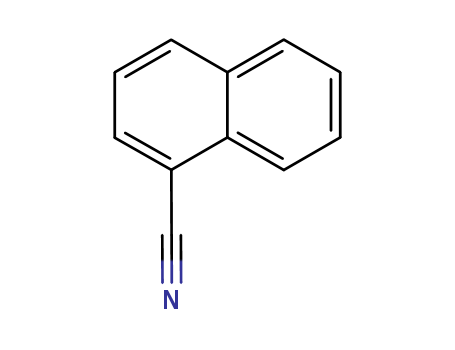 1-Cyanonaphthalene
CAS:86-53-3
-
-